When Renting One Movie Costs Less Than Starting Another Streaming Subscription
When Renting One Movie Costs Less Than Starting Another Streaming Subscription
In an increasingly fragmented digital entertainment market, viewers frequently experience “subscription fatigue.” When you want to watch a specific movie, you are usually faced with two options: pay a few dollars to rent that single title for 48 hours, or sign up for a new Over-The-Top (OTT) streaming subscription with a recurring monthly fee.
Although subscribing to a monthly service appears to offer a “massive library of content,” in many real-world scenarios, paying to rent a single film proves to be a smarter and more cost-effective financial decision. Understanding the underlying business models of these platforms helps you optimize your personal entertainment budget.
The Context of “Subscription Fatigue” and the Cost Equation
The modern media landscape has shifted dramatically from centralized platforms to extreme fragmentation. Every major movie studio now operates its own proprietary streaming service, forcing consumers to carry multiple recurring monthly fees if they want comprehensive access to entertainment content.
The Cumulative Cost Trap of SVOD Bloat
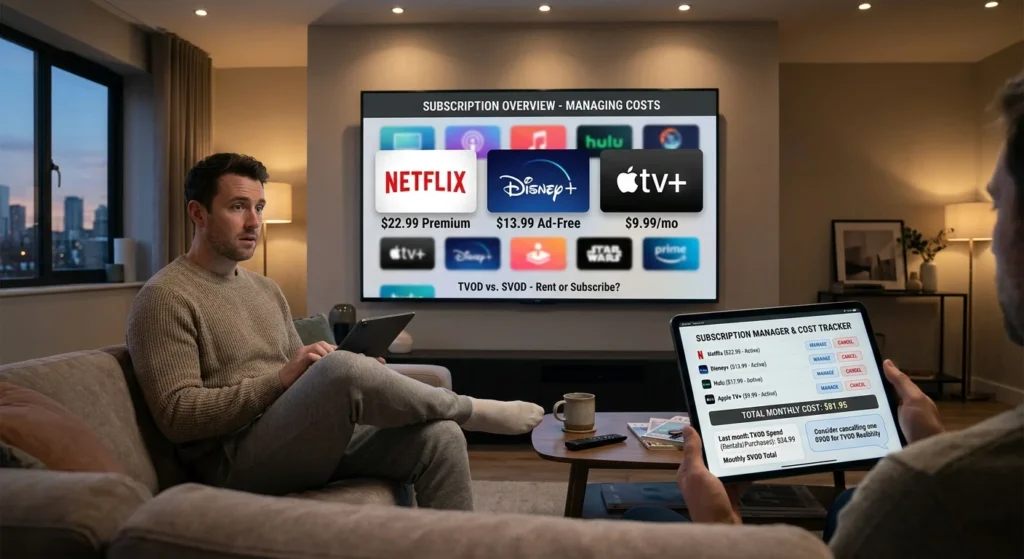
When subscribing to a monthly Subscription Video on Demand (SVOD) service such as Netflix, Disney+, Max, or Paramount+, users commit to paying a fixed recurring fee typically ranging from $7.99 to $22.99 per month depending on video quality and ad-supported tiers.
The financial problem arises when you sign up for a new platform solely to watch a single newly released or exclusive movie. The initial $10 or $15 fee seems small on its own, but when accumulated alongside 4 to 5 other services that you rarely open, your total annual entertainment expenditure can quietly escalate out of control into hundreds of dollars.
Comparing Digital Movie Rentals (TVOD) vs. Monthly Subscriptions (SVOD)
To make an accurate decision, it is essential to distinguish between the two primary digital content distribution models in use today:
- TVOD (Transactional Video on Demand): You pay strictly for a single specific title under a temporary rental or permanent purchase model via digital storefronts like Apple TV (iTunes), Google TV, Amazon Prime Video, or YouTube Movies. Standard rental prices for a feature film typically range from $3.99 to $5.99.
- SVOD (Subscription Video on Demand): You pay a recurring fee (monthly or annually) to gain unlimited access to the provider’s entire catalog of content.
When Is Renting a Single Movie the Cheaper Option?
Having access to an entire movie library does not always translate into practical value. Below are specific scenarios where renting a single movie provides clear financial benefits.
1. You Only Want to Watch One Specific Movie
If your intention is simply to enjoy a single award-nominated film or a movie recommended by a friend, renting is the optimal choice. Consider the direct comparison:
- Single Movie Rental (TVOD): $3.99 – $5.99 for a single view.
- New Subscription (SVOD): $9.99 – $19.99 for the first month.
At the moment of transaction, you save anywhere from 50% to 75% upfront. If you do not intend to watch any other titles on that platform over the next 30 days, the remaining cost of the monthly subscription is entirely wasted.
2. Eliminating the Auto-Renewal Trap
A core revenue strategy for SVOD platforms relies on users who “forget to cancel” after their first paid month or free trial ends.
When you rent a single movie, the transaction closes permanently once your 48-hour viewing window expires. There are no credit card details retained for automatic monthly billing, no calendar reminders to set, and no complicated cancellation procedures to navigate. This psychological peace of mind is an intangible but highly valuable benefit.
3. Ad-Free Experience at a Lower Cost
Today, most entry-level SVOD plans ($6.99 to $9.99/month) include unskippable commercial breaks during movie playback. To enjoy an ad-free experience, you are forced to upgrade to premium tiers priced between $15 and $23/month.
In contrast, renting an individual film (TVOD) on platforms like Apple TV or Google TV guarantees top-tier video and audio quality (4K HDR, Dolby Vision/Atmos) without any commercial interruptions, all for the standard baseline rental price of $3.99 – $5.99.
4. Newly Released Theatrical Films (PVOD vs. SVOD)
Many blockbuster films transitioning out of movie theaters enter a PVOD (Premium Video on Demand) window, priced around $19.99 for early home rental before they become available on monthly subscription services months later.
While $19.99 is higher than a single month of a basic streaming subscription, hosting a movie night at home for a family or a group of 3 to 4 friends still costs significantly less than purchasing multiple theater tickets, snacks, and transportation.
The Breakeven Calculation Framework for Viewers
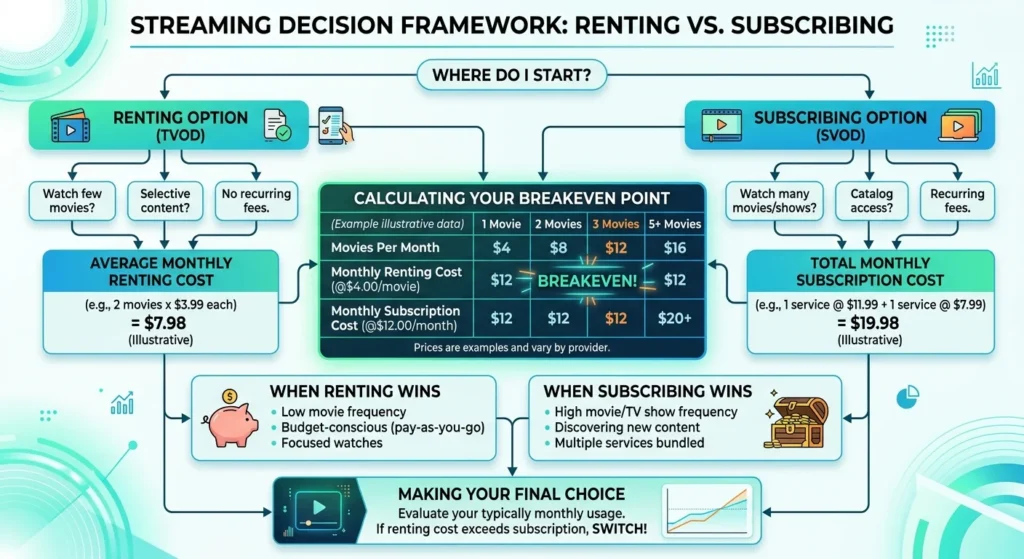
To determine precisely when to rent versus when to subscribe, you can apply a breakeven calculation based on your personal viewing habits.
Frequency Formula Around the Breakeven Point
Let P_rental represent the average rental price of a single movie ($4.99) and P_sub represent the ad-free monthly subscription price of the platform ($14.99).
Breakeven Point (Number of Movies) = P_sub / P_rental = 14.99 / 4.99 = 3 movies
- If you watch fewer than 3 movies per month on that specific platform: Choose single movie rentals (TVOD).
- If you consistently watch 3 or more movies per month: Subscribing to a monthly plan (SVOD) becomes more cost-effective on a per-view basis.
Content Rotation Rate
SVOD platforms constantly add and remove licensed titles every month. A movie you might have to rent today could arrive on a subscription service you already pay for next month. Before clicking the rental button, use global streaming lookup tools (such as JustWatch) to confirm that the title is not already available on one of your active subscriptions.
Decision Matrix: Single Movie Rental vs. Long-Term Subscription
| Evaluation Factor | Single Movie Rental (TVOD) | Monthly Subscription (SVOD) |
|---|---|---|
| Intended Watching Volume | Only 1 or 2 specific movies | 3+ movies or multi-episode TV series |
| Platform Usage Frequency | Occasional / Spontaneous | Regular weekly viewing |
| Ad-Free Requirement | Ad-free included at standard price ($3.99) | Requires higher-tier plan to disable ads |
| Financial Risk | One-time charge, zero auto-billing risk | Risk of forgotten monthly recurring charges |
| Access Window | 30 days to start, 48 hours after clicking Play | 30 days of unlimited platform access |
Frequently Asked Questions
Do individual movie rentals (TVOD) on Apple TV or Amazon Prime Video have time limits?
Yes. When you rent a movie, you are usually given 30 days to begin watching. However, once you press the Play button, you have a 48-hour window (in most markets) to finish watching or rewatch the movie as many times as you like before the rental expires.
If a movie is listed under Premium VOD ($19.99), should I wait for it to join a monthly subscription service?
That depends on your urgency and viewing context. If you want to experience a new release immediately with family or friends at home, $19.99 is cost-effective compared to theater tickets. If you are not in a hurry, the rental price typically drops to the standard $3.99–$5.99 tier within 2 to 4 weeks, or joins an SVOD library within 4 to 6 months.
How can I manage my streaming subscriptions to avoid wasting money every month?
You can adopt the “Subscription Cycling” method. Subscribe to only one SVOD service at a time, watch the specific shows or movies you want during that month, cancel the auto-renewal immediately, and switch to a different streaming provider the following month.
Do all streaming services offer single movie rentals (TVOD)?
No. Pure SVOD platforms like Netflix or Disney+ do not offer individual movie rentals; they require a full subscription. Conversely, storefronts like Apple TV, Google TV, Amazon Prime Video, and YouTube Movies offer both individual rentals and integrated subscription add-ons side by side.